Please read Janet Walker’s, Westerns: Films Through History. -Introduction: Westerns Through History (pg 1-27), and write a summary (no less than 700 words) in which you outline the most important aspects of the reading. (In folder “Semana 7”)
Monthly Archives: August 2009
The Western & the Westerner
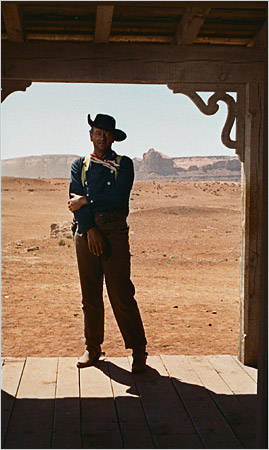
** Notes on Robert Warshow’s – Movie Chronicle : The Westerner
The title indicates that Warshow is more concerned about the westerner – the western hero-, than the genre itself. However, the western is pretty much defined by its hero and the hero, particularly in the western and in action movies, is the driving force of the film.
Warshow compares the hero of the gangster movie to that of the western in order to:
– Show the differences in both
– Discuss the parallel between both men’s use of guns
– Compare their positions as outsiders
– Contrast their melancholy and loneliness
The outcome shows that “the westerner” – the hero at the center of The western is:
1. A figure of repose
2. Sort of a zen character who understands the world and its code (comes as no surprise to us that Seven Samurai inspired The Magnificent Seven – where the samurai code is equivalent to the code of honor of the western hero)
3. His melancholy comes from the simple recognition that life is hard and serious.
4. Although we never see him working we recognize that there are no luxuries in his lifestyle, – that he has a hard life.
5. Love is not on his side in the sense that he is bound to be doomed and cannot settle for love – there tends to be something of a higher power that calls him
6. Usually the territory is lawless and the westerner is due to set precedent with his actions
7. He will protect those who are weak from the perils of the evil that surrounds the landscape and from the harshness of the landscape itself.
The Western Myth – Approaching genre theory from the western.
Westerns have occupied a very important place in the discussion on genre theory. Despite the fact that westerns are not as popular as they used to be in the 40’s and 50’s, the western is still central to the theoretical approaches to genre.
Continue reading The Western Myth – Approaching genre theory from the western.
Assignments for August 26th
Please read:
Robert Warshow´s, Movie Chronicle: The Westerner (pg 654-667)
Write a text in which you discuss the characteristics of “the westerner” described by Warshow and the traits you found in the movie we watched in class: Stagecoach.
Also, please read:
“The western: or the American film par excellence” and “The evolution of the western”, both by Andre Bazin.
Please write a series of three questions and three answers for both texts.
The only ones who are exempt from handing in the homework are Natalia, Alvaro & Herberth, who are doing a presentation on “comedy”. They are not exempt, however, from doing the readings.
Assignments for August 19th
Chapter 3 from Rick Altman´s, Film / Genre. – The Western (pg 34-38)
Steve Neale´s, Genre and Hollywood: Westerns (pg 133-142)
For each text, please write a set of three questions, with the corresponding answers.
Readings can be found here: ftp://ftp.icesi.edu.co/mlcuellar/, in the subfolder called “semama 4”
The musical and it’s narrative
According to Dyer there are three kinds of musicals:
1. Those that keep the narrative and the musical numbers clearly separated: (mostly where the numbers appear to be part of a show like Cabaret)
2. Those that retain the division between narrative as problems and musical numbers as escape (where one more or less can tell when the musical number will appear as it tends to be cued – The Wizard of Oz)
3. Those which try to dissolve the distinction between narrative and numbers, thus implying that the world in which the narrative takes place is also utopian. (Moulin Rouge – utopic world of artists and performers being more sensitive – yet one can argue that MR combines all three)
How are genres useful?
1. As a marketing device – to draw audiences to the theater – if one person enjoyed “Spider Man” then they will most likely want to see “Hulk“, therefore investors are more keen to invest….
2. Reference tool – people understand (implicitly) more or less what is at stake with a particular genre because they have a frame of reference.
3. Category used to define and analyze films. However, not to evaluate as it does not give value – it gives a sense -.
What tools help us define genre?
What elements can we refer to when we need to differentiate between genres?
1. Subjects and themes
2. Presentation (in the musical for example – musical = signing + dancing)
3. Emotional effect (horror = fear, comedy = laughter)
4. Genre conventions of narrative and style
5. Plot elements
6. Thematic meanings (example: road movies = on the road, searching for something)
7. Film techniques (dark, light somber, mysterious, or happy, colorful)
8. Genres can also be defined through conventional iconography (recurring symbolic images that carry meaning from film to film, ie the cars in the old gangster movies, the space ships in Sci-Fi, the suits in Film Noir. Actors can also work as icons like Bruce Willis and Arnold Schwarzenegger = action movies)
9. Elements of its form like costumes, music, etc.
What can we say about genres and genre theory?
1. Lacks a scientific precision in its definition
2. They developed in an informal way
3. Everyone (critics, producers, audiences, actors) have contributed to the formation of genres and to the shared sense that some films may relate to others
4. Genres change over time (directors and actors may add a twist to their work (in form or style) that adds to a different viewing of the genre). This constant change makes it difficult to define the boundaries Continue reading What can we say about genres and genre theory?
Assignments for August 12
Read:
Richard Dyer’s essay in Steven Cohan’s, Hollywood Musicals, The Film Reader:
– Richard Dyer, Entertainment and Utopia. (pg 17-30)
Abstract from the second chapter of Steve Neale’s, Genre and Hollywood: Musicals (pg. 104-112)
Watch Lars Von Trier’s, Dancer in the Dark, 2000
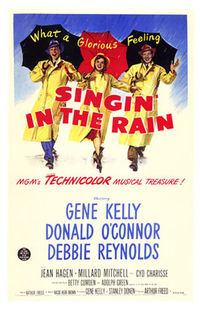
1. Write a small piece on the movie we watched in class (Singin´ in the Rain). Use both, Steven Cohan’s Introduction and Richard Dyer’s text as a guideline. Try to address the peculiar aspects of the film, for example; how the narrative unfolds, the relationship between the dance and singing scenes with the story, etc.
2. Write a text comparing Singin’ in the Rain to Dancer in the Dark and both films relation to Utopia (based on Dyer’s text).